Is Java Pass by Value or by Reference?
Java is always pass by value. No exceptions.
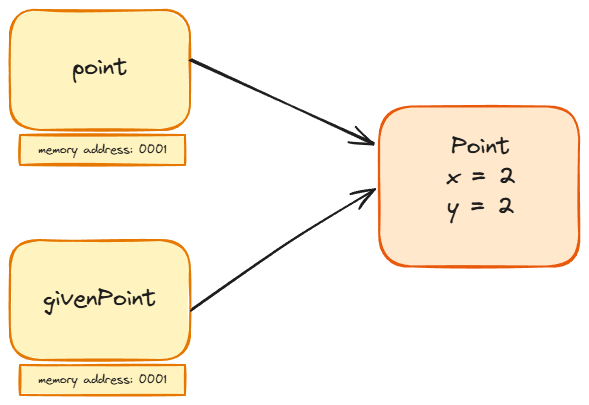
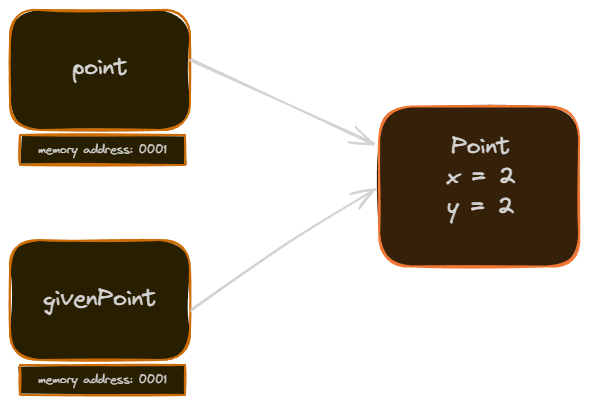
The confusion arises because when you pass an object to a method, what gets passed is the value of the reference (the memory address of the object), not the object itself. The method receives its own copy of that reference. Both the original variable and the parameter point to the same object in memory, which makes it look like pass by reference, but it is not.
Modifying an Object Through a Copied Reference
1
2
3
4
5
6
7
8
9
class Point {
    int x;
    int y;

    public Point(int x, int y) {
        this.x = x;
        this.y = y;
    }
}
1
2
3
4
5
6
7
8
9
10
11
class Test {
    public static void main(String[] args) {
        Point point = new Point(2, 2);
        changeX(3, point);
        System.out.println("X: " + point.x);
    }

    public static void changeX(int x, Point givenPoint) {
        givenPoint.x = x;
    }
}
Output:
1
X: 3
The method changeX receives a copy of the reference that point holds. Both point and givenPoint point to the same Point object in memory, so modifying givenPoint.x changes the same object the caller sees.
Reassigning the Reference Inside a Method
1
2
3
4
5
6
7
8
9
10
11
12
class Test {
    public static void main(String[] args) {
        Point point = new Point(2, 2);
        replaceAndChangeX(5, point);
        System.out.println("X: " + point.x);
    }

    public static void replaceAndChangeX(int x, Point givenPoint) {
        givenPoint = new Point(0, 0);
        givenPoint.x = x;
    }
}
You might expect the output to be 5, but it is:
1
X: 2
When the method starts, givenPoint holds the same address as point. But the line givenPoint = new Point(0, 0) reassigns the local copy to a brand-new object. From that point on, givenPoint and point refer to different objects. Setting givenPoint.x = 5 modifies the new object, which the caller never sees.
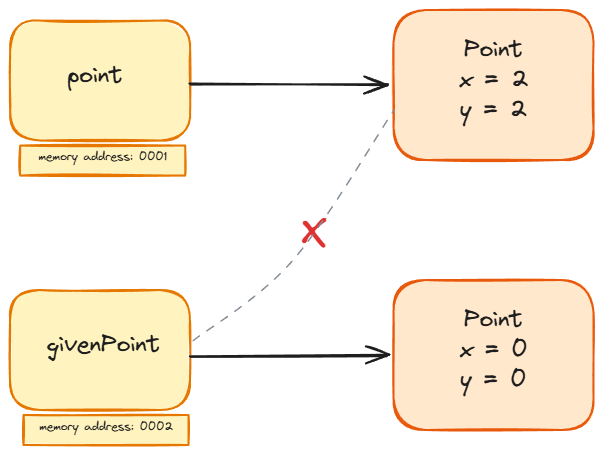
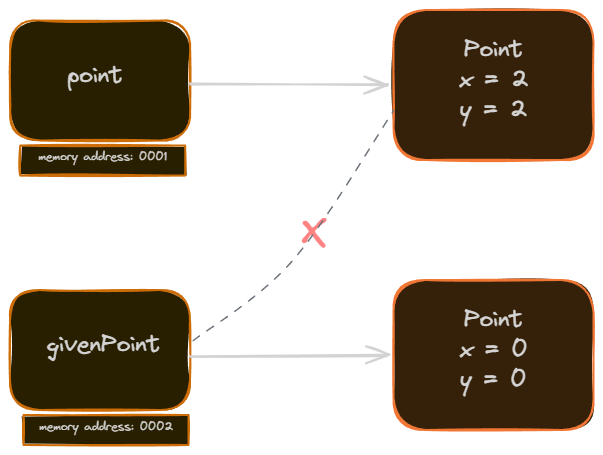
This is the definitive proof that Java is pass by value. If it were pass by reference, reassigning givenPoint inside the method would also change point in the caller. It does not.
Primitives
For primitive types (int, double, boolean, etc.), the situation is simpler. Variables hold the values directly, not references. Passing a primitive to a method copies the value itself. Changes inside the method have no effect on the caller’s variable:
1
2
3
4
5
6
7
8
9
public static void tryToChange(int x) {
    x = 99;
}

public static void main(String[] args) {
    int value = 10;
    tryToChange(value);
    System.out.println(value); // 10
}
Arrays
The same pass-by-value rule applies to arrays. When you pass an array to a method, Java copies the reference to the array, not the array itself. The method can modify the array’s elements (because both references point to the same array object), but reassigning the parameter to a new array will not affect the original:
1
2
3
4
5
6
7
8
9
10
11
12
13
14
15
16
public static void modifyArray(int[] arr) {
    arr[0] = 99;
}

public static void replaceArray(int[] arr) {
    arr = new int[] {10, 20, 30};
}

public static void main(String[] args) {
    int[] numbers = {1, 2, 3};
    modifyArray(numbers);
    System.out.println(numbers[0]); // 99 (same array object was modified)

    replaceArray(numbers);
    System.out.println(numbers[0]); // 99 (reassignment inside the method had no effect)
}
Summary
| What is passed | What gets copied | Can the method modify the original? |
|---|---|---|
| Primitive | The value itself | No |
| Object reference | The address (reference value) | It can modify the object’s fields, but it cannot make the caller’s variable point to a different object |
Related posts: Java Memory Management