Inversion of Control and Dependency Injection
Consider a program that manages songs: you can search them, read details, and discover interesting facts about each. There would probably be a class that searches for those songs by asking some external provider.
The Problem: Hidden Dependencies
A first attempt might look like this:
1
2
3
4
5
6
7
8
class SongLister {

    public final SpotifySongsProvider provider = new SpotifySongsProvider();

    public Collection<Song> songsByArtist(String artistName) {
        return provider.findSongsByArtist(artistName);
    }
}
This implementation has several problems. The field is public, so anyone can replace or misuse the provider directly. It uses a concrete class (SpotifySongsProvider) instead of an abstraction, so the lister is tightly coupled to Spotify. And the provider is instantiated inline, so there is no way to swap it for a different implementation or a test double without modifying the class.
I want songsByArtist to be completely independent of the provider. In other words, what we do should not be limited by how we do it. The source of songs should be an implementation detail behind an abstraction.
The first step is extracting an interface that defines the contract:
1
2
3
public interface SongsProvider {
    List<Song> findSongsByArtist(String artistName);
}
Now let’s try using the interface, but still creating the concrete implementation inside the constructor:
1
2
3
4
5
6
7
8
class SongLister {

    private final SongsProvider provider;

    public SongLister() {
        this.provider = new SpotifySongsProvider();
    }
}
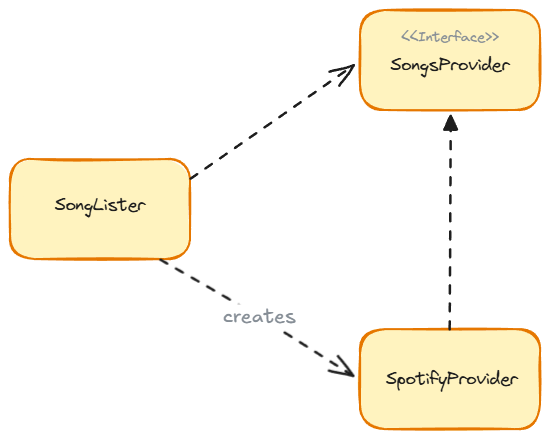
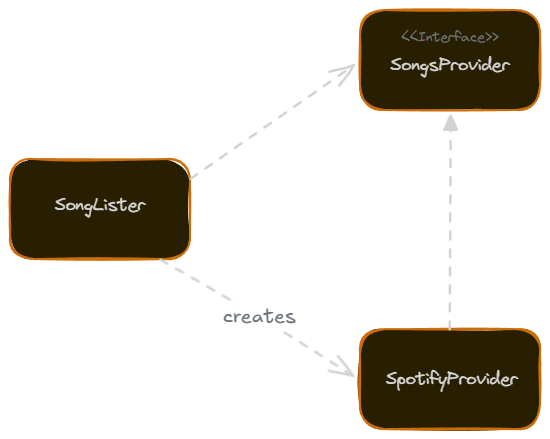
This is better, but SongLister still depends on SpotifySongsProvider. If we want to use a different source of songs (say, a local file for development or a different streaming service in production), we have to change the class. We would like providers to be interchangeable plugins, but by directly instantiating one, we lose that flexibility.
What Is Inversion of Control?
Inversion of Control (IoC) is a principle that transfers control over object creation and wiring from the objects themselves to an external entity: a framework, a container, or simply the calling code.
Without IoC, the SongLister decides which provider to create. With IoC, something outside the SongLister makes that decision and supplies the provider. The key advantages:
- Decoupling between what a class does and how its dependencies are provided
- Components become configurable and easily extendable
- Easier testing (dependencies can be replaced with test doubles)
- Greater modularity and separation of concerns
IoC is a broad concept. It can be achieved through several mechanisms: the Strategy pattern, the Factory pattern, the Service Locator pattern, and Dependency Injection (DI).
Worth noting: while the Service Locator pattern technically achieves IoC, it is widely considered an anti-pattern in modern applications. The key issue is that it hides class dependencies instead of making them explicit, which makes the code harder to reason about and test. With a Service Locator, you cannot tell from a class’s constructor what it depends on. You only discover missing dependencies at runtime. Dependency Injection, by contrast, makes every dependency visible and explicit.
Dependency Injection
Dependency Injection is the most widely used form of IoC. Instead of a class creating or locating its own dependencies, an external assembler “injects” them. The class declares what it needs (through a constructor parameter, a setter, or a field), and someone else provides it.
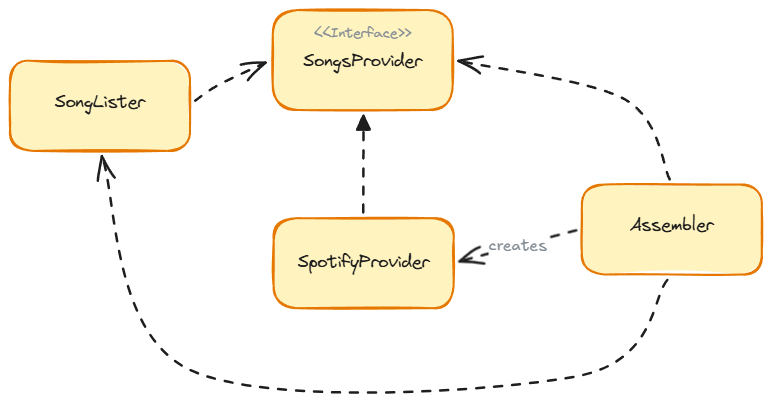
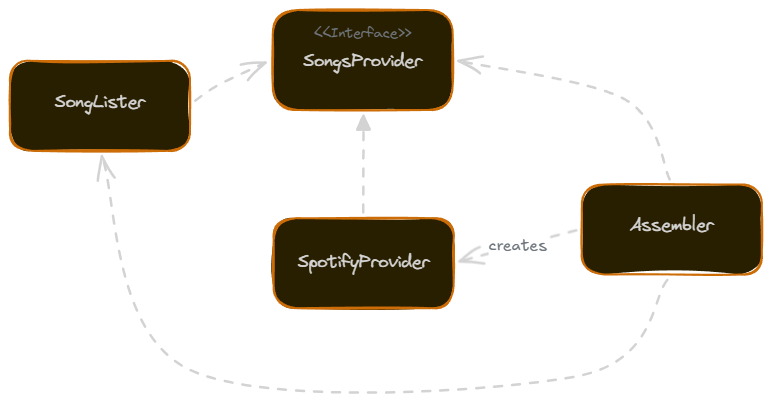
Applied to our example, the SongLister now expects a SongsProvider in its constructor instead of creating one:
1
2
3
4
5
6
7
8
9
10
11
12
class SongLister {

    private final SongsProvider provider;

    public SongLister(SongsProvider provider) {
        this.provider = provider;
    }

    public Collection<Song> songsByArtist(String artistName) {
        return provider.findSongsByArtist(artistName);
    }
}
The caller decides which implementation to use:
1
2
3
SongLister lister = new SongLister(new SpotifySongsProvider());
// or for local development:
SongLister lister = new SongLister(new LocalFileProvider());
This gives us the flexibility to swap providers without any changes to SongLister. For me, a more descriptive name for this concept would be “configurable dependency” rather than “dependency injection.”
Types of Dependency Injection
There are three common ways to inject dependencies.
Constructor injection passes dependencies through the constructor. This is the recommended approach for required dependencies because it makes them explicit, enforces that the object is fully initialized before use, and allows fields to be final.
1
2
3
4
5
6
7
8
class SongLister {

    private final SongsProvider provider;

    public SongLister(SongsProvider provider) {
        this.provider = provider;
    }
}
Setter injection provides dependencies through setter methods after construction. This is suitable for optional dependencies that have reasonable defaults.
1
2
3
4
5
6
7
8
class SongLister {

    private SongsProvider provider = new DefaultProvider();

    public void setProvider(SongsProvider provider) {
        this.provider = provider;
    }
}
Field injection sets dependencies directly on fields, typically using reflection. This approach is generally discouraged outside of tests for several reasons:
- It hides dependencies, making it impossible to tell what a class needs by looking at its constructor
- It prevents fields from being
final, since the field must be writable after construction - It relies on reflection, which bypasses Java’s access control mechanisms
- It makes unit testing harder without a DI framework
- It makes it easy to keep adding dependencies without noticing that the class is doing too much, violating the Single Responsibility Principle
1
2
3
4
5
class SongLister {

    @Inject
    private SongsProvider provider;
}
Circular Dependencies
One pitfall to watch out for with dependency injection is circular dependencies: A depends on B, and B depends on A. When a DI container tries to create A, it needs B first, but creating B requires A, which has not been created yet. The container cannot resolve this cycle and will fail at startup (in Spring, you get a BeanCurrentlyInCreationException).
The best solution is to redesign the dependency graph so the cycle does not exist. Usually a circular dependency signals that two classes are too tightly coupled and some responsibility should be extracted into a third class. If redesigning is not immediately practical, other options include introducing an interface to break the cycle or using lazy initialization (@Lazy in Spring) so that one of the dependencies is resolved through a proxy and only created when first accessed. Treat lazy initialization as a temporary workaround, not a permanent fix.
Dependency Injection in Spring
Spring is the most widely used DI framework in the Java ecosystem. It manages object creation and lifecycle through its application context (the IoC container) and injects dependencies based on configuration or annotations.
Spring supports all three injection types. For constructor injection, if a class has a single constructor, Spring uses it automatically without requiring the @Autowired annotation (since Spring 4.3). This further reinforces constructor-based injection as the idiomatic default in Spring applications.
1
2
3
4
5
6
7
8
9
@Service
class SongLister {

    private final SongsProvider provider;

    public SongLister(SongsProvider provider) {
        this.provider = provider;
    }
}
For setter injection, Spring calls the annotated setter after constructing the bean:
1
2
3
4
5
6
7
8
9
10
@Service
class SongLister {

    private SongsProvider provider;

    @Autowired
    public void setProvider(SongsProvider provider) {
        this.provider = provider;
    }
}
Spring documentation recommends setter-based injection for optional dependencies.
For field injection, Spring uses reflection to set the field directly:
1
2
3
4
5
6
@Service
class SongLister {

    @Autowired
    private SongsProvider provider;
}
Field injection is the most concise syntax, but it carries all the disadvantages described earlier. The only scenario where it is generally acceptable is in test classes, where brevity outweighs the design concerns.
You can also wire beans explicitly using a @Configuration class. This is useful when you need to configure third-party classes or want all wiring logic in one place:
1
2
3
4
5
6
7
8
9
10
11
12
13
@Configuration
class SongConfig {

    @Bean
    SongsProvider songsProvider() {
        return new SpotifySongsProvider();
    }

    @Bean
    SongLister songLister(SongsProvider songsProvider) {
        return new SongLister(songsProvider);
    }
}
Spring picks up the configuration, creates the beans, and injects them in the correct order. The SongLister bean receives the SongsProvider through constructor injection, exactly as if we had wired it manually.
Related posts: SOLID: The First 5 Principles of Object Oriented Design
References
- Martin Fowler, Inversion of Control
- Martin Fowler, Inversion of Control Containers and the Dependency Injection pattern
- Baeldung, Intro to Inversion of Control and Dependency Injection with Spring